148958 stories
·
0 followers

Former German spy chief arrested on suspicion of attempted treason, obtaining state secrets

1 Share

Item 1 of 3 August Hanning, state secretary at the German Interior Ministry and former head of Germany's Federal Intelligence Service (BND), attends a parliamentary committee of investigation in Berlin, Germany, November 30, 2006. REUTERS/Fabrizio Bensch/File Photo

[1/3]August Hanning, state secretary at the German Interior Ministry and former head of Germany's Federal Intelligence Service (BND), attends a parliamentary committee of investigation in Berlin, Germany, November 30, 2006. REUTERS/Fabrizio Bensch/File Photo Purchase Licensing Rights, opens new tab

BERLIN, Oct 6 (Reuters) - Former German foreign intelligence chief August Hanning was arrested ​on Tuesday on suspicion of attempted treason for allegedly paying to access secret ‌documents and using them to prepare an analysis for a foreign spy service, federal prosecutors said.

Prosecutors did not identify the foreign intelligence service, and it was not immediately clear whether the analysis reached its intended recipient.

Get a look at the day ahead in U.S. and global markets with the Morning Bid U.S. newsletter. Sign up here.

"Hanning is strongly ​suspected of treasonous espionage, obtaining state secrets, attempted treason and espionage," the prosecutor's office said ​in a statement.

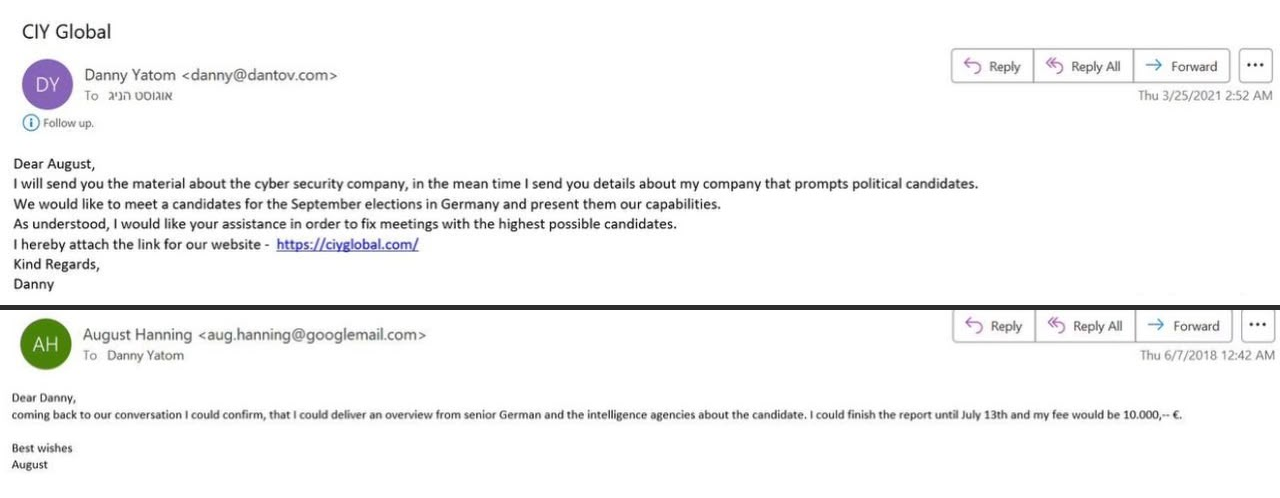
Five years after his seven-year tenure as head of the BND ⁠intelligence service ended in 2005, Hanning agreed with a former BND office manager to receive confidential ​intelligence information in exchange for payment, according to prosecutors.

The office manager, identified as Manfred D. in line ​with privacy rules, was also arrested on Tuesday and both were due to appear before a judge at the Federal Court of Justice.

'NO COMPROMISES'

Prosecutors said D. is suspected of having supplied around 2,000 documents over the years, including ​classified material intended solely for internal use within the BND and senior-level intelligence briefings at the ​chancellery.

According to prosecutors, Hanning used classified information supplied by D. to prepare an analysis for an officer of a ‌foreign ⁠intelligence service and for years shared political information with a representative of the spy agency.

According to information obtained by the SZ newspaper, the case does not involve Russia.

BND President Martin Jaeger said the agency had launched extensive internal investigations as soon as suspicions emerged, adding that "there can be no compromises ​on internal security."

Hanning did ​not respond to a ⁠request for comment from Reuters. The chancellery declined to comment.

PAST SPY SCANDALS

Hanning's arrest is the latest in a series of notorious espionage scandals in Germany.

West ​German Chancellor Willy Brandt was forced to resign in 1974 after it ​was revealed ⁠that an East German spy had worked as his close aide for nearly two years. In 1990, a senior West German counter-intelligence official was exposed for spying for East Germany throughout the 1980s and was ⁠later ​convicted of treason.

More recently, former domestic intelligence chief Hans-Georg Maassen ​said in 2024 he was now being monitored by the security agency he once ran over alleged right-wing political extremism, which ​he denied.

Adds quote from prosecutors' statement in paragraph 3, BND statement in paragraph 9, background on past spy scandals in paragraph 11

Reporting by Friederike Heine, additional reporting by Andreas Rinke; editing by Linda Pasquini and Alexandra Hudson

Our Standards: The Thomson Reuters Trust Principles., opens new tab

Read the whole story
Michael_Novakhov
10 minutes ago
reply
http://michael_novakhov.newsblur.com/
Share this story
Delete

august hanning - Google Search

1 Share

AI Mode Conversation: august hanning

AI Mode reply for august hanning

August Hanning, the former head of Germany's foreign intelligence service (BND), was arrested on October 6, 2026, on charges of treasonous espionage, obtaining state secrets, and attempted treason.

Federal prosecutors announced that the 80-year-old former spy chief is suspected of paying a former aide for access to classified government documents to prepare an intelligence analysis for a foreign spy agency.

Case Details

  • The Alleged Plot: Prosecutors state that in 2010—five years after his tenure leading the BND ended—Hanning established an arrangement with his former bureau chief, identified as Manfred D.. Manfred D. allegedly leveraged his subsequent roles within the agency to leak roughly 2,000 documents (many highly classified) to Hanning in exchange for regular payments.
  • The Foreign Recipient: Hanning allegedly used the documents to craft intelligence briefs for an undisclosed foreign intelligence service and maintained regular contact with another. Authorities have not yet publicly revealed the foreign nations involved.
  • Coordinated Arrests: Hanning was arrested at his home in Nordwalde, while Manfred D. was detained simultaneously. Manfred D. has been charged with aiding and abetting treason.
  • Unusual Discovery: Investigators reportedly uncovered the espionage material during a September 2025 search of Hanning's office related to a completely separate, high-profile investigation involving a German steakhouse heiress's child custody dispute.

Career Background

  • BND President (1998–2005): Hanning led the Federal Intelligence Service (BND) for seven years, navigating major geopolitical events including the aftermath of the September 11 attacks and the Iraq War.
  • State Secretary (2005–2009): After his intelligence career, he served as a top official within Germany's Federal Interior Ministry.
  • Private Sector & Financial Strain: After leaving government service, he operated as a corporate consultant and sat on several boards. German media reports indicate Hanning faced severe financial hardships in recent years after losing a significant portion of his pension in the 2019 collapse of a Latvian bank.

Copied to clipboardFailed to copy to clipboard. Try again later.

  • Former German spy chief arrested on suspicion of ... - Reuters

    Hanning was arrested on Tuesday on suspicion of attempted treason for allegedly paying to access secret documents

  • Germany's ex-spy chief arrested for espionage

    Hanning, the man who once led Germany's spy service, is now under investigation by prosecutors for passing on state secrets.

  • German Officials Arrest Former Spy Chief on Espionage ...

    August Hanning, 80 — Hanning left his post and worked as a consultant, joining several corporate boards.

Read the whole story
Michael_Novakhov
15 minutes ago
reply
http://michael_novakhov.newsblur.com/
Share this story
Delete

Germany's ex-spy chief arrested for espionage and treason

1 Share

Police have arrested the former head of Germany's BND foreign intelligence agency, August Hanning, on suspicion of espionage, the federal prosecutor's office announced Tuesday.

Hanning served as the agency's chief from December 1998 to November 2005, before moving to the Federal Interior Ministry where he worked as state secretary until November 2009. 

According to a statement from the prosecutor's office, he is facing charges including alleged espionage, disclosure of state secrets, attempted treason, and working as a secret service agent.

The statement added that another former high-ranking employee of the BND had also been arrested on suspicion of providing Hanning with hundreds of classified documents in exchange for payment.

DW's chief political editor Michaela Küfner, reporting from a government press briefing on the arrest, described the case as Germany's "biggest espionage scandal of the century unfolding in real time."

The BND building in Berlin

Hanning's alleged informant worked as chief of staff for multiple BND headsImage: Joko/picture alliance

What else do we know about the investigation?

Police arrested Hanning early Tuesday at his home in Nordwalde near the western German city of Münster, according to information from WDR, NDR and the Süddeutsche Zeitung.

Hanning's alleged accomplice, who was identified only as Manfred D. in line with Germany's privacy laws, was taken into custody in Bavaria.

Authorities were conducting searches at both suspects' properties, as well as in Berlin, the prosecutor said.

During Hanning's tenure as spy head, D. served as his chief of staff. He also subsequently worked under Hanning at the Interior Ministry until 2009.

He is facing charges of "aiding and abetting attempted treason and espionage against the state."

Marc Henrichmann, who chairs the German parliament's intelligence oversight committee, said following the arrests that Germany "will not tolerate the betrayal of secrets."

"Whoever allies themselves with the enemies of our liberal democracy will be found out," he said in comments to the AFP news agency.

The investigation in Hanning reportedly began due to his connection to a high-profile trial involving businesswoman Christine Block.

2,000 documents allegedly handed over to Hanning

The prosector's office said Hanning and Manfred D. are believed to have come up with their arrangement in 2010.

From 2012 to March 2026, D. served as chief of staff to Hanning's successors at the BND spy agency, where he had access to a wealth of classified documents, according to the prosecutor's statement.

"The current findings suggest that, over the years, Manfred D. provided Hanning with approximately 2,000 documents, many of which contained classified information to be used exclusively by the Federal Intelligence Service for internal purposes," the statement said.

It added that D. is alleged to have provided Hanning with information until at least mid-2022, and that Hanning used that information in his private consulting work.

Hanning is also accused of being "in close contact with a representative of another foreign intelligence service, to whom he passed on political information, partially based on material provided by Manfred D., for several years," the statement said.

The prosecutor's office did not say which foreign intelligence service was involved.

The two suspects are expected to appear before an investigating judge on Tuesday and Wednesday.

Edited by: Elizabeth Schumacher

Don't let the algorithm hide the news. If you rely on our team for trusted reporting, please take a moment to select us as your Preferred Source on Google, so you'll always see our verified news first.

Read the whole story
Michael_Novakhov
3 hours ago
reply
http://michael_novakhov.newsblur.com/
Share this story
Delete

FBI gives employees a classified 'Patel Report' about times the agency 'fell short'

1 Share

WASHINGTON (AP) — The FBI has released a classified report to its workforce examining what it says are chapters from the bureau's history "where this institution fell short," according to an internal message obtained Friday by The Associated Press.

It was unclear what episodes from the FBI's past are chronicled in the new "Patel Report." But the document's existence is in keeping with Director Kash Patel's vocal criticism of the leaders who preceded him and with his determination to rid the FBI of agents he contends have politicized the bureau in the past. Patel's critics say he is the one who has weaponized the FBI and that his scrutiny of his predecessors and their decision-making is part of an effort to rewrite history in favor of President Donald Trump.

READ MORE: 3 FBI agents fired over Trump investigation get broad backing in lawsuit against administration

Patel pledged at his confirmation hearing last year that he would not look "backward," but as director, he has encouraged investigations of former senior officials and presided over sweeping terminations, including of employees who participated in years-old investigations of Trump, were photographed taking a knee during a 2020 racial justice protest and contributed to a disputed analytical memo about Catholic extremism.

Educate your inbox

Subscribe to Here’s the Deal, our politics newsletter for analysis you won’t find anywhere else.

"The Patel Report looks backward because accountability demands it," says a message to the workforce signed by the FBI's co-deputy directors, Christopher Raia and Andrew Bailey. The message describes the report as marking the "closing of one chapter in our history and the beginning of another complete with a brighter future ahead."

Bailey announced his resignation earlier this week, and his last day is Friday. The FBI declined to comment on the report.

The message also says: "We cannot change what happened before we arrived. But we can confront it honestly. We can recognize failures instead of protecting them. We can hold people accountable. We can fix what was broken. And we can build safeguards strong enough to ensure the mistakes of the past are never allowed to define this institution again. These steps are consistent with any institution of excellence that is constantly striving for improvement."

It was unclear if the report made recommendations or demanded any action to address what the FBI now regards as past shortcomings.

The FBI message says the report is meant to "promote fierce organizational accountability" and rebuild "public trust." But Patel's critics say the politically charged investigations into perceived adversaries of Trump that the FBI has embarked on under his watch, as well as the punishment of agents who participated in investigations into the Republican president to which they were assigned, have eroded faith in the nation's premier federal law enforcement agency.

A free press is a cornerstone of a healthy democracy.

Support trusted journalism and civil dialogue.

Read the whole story
Michael_Novakhov
1 day ago
reply
http://michael_novakhov.newsblur.com/
Share this story
Delete

news - Google Search

1 Share

AI Mode Conversation: news

You said: news

AI Mode reply for news

Here are the top headlines and major breaking news stories from around the world today, October 4, 2026:

🚨 Major Security & International Incidents

  • FlyDubai Hijacking Attempt Foil: Disclosed details reveal that hero passengers successfully subdued a co-pilot who attempted to crash a Boeing 737 Max into the Arabian Desert this past Wednesday. The suspect had previously been flagged as a security risk.
  • US Marine Arrested in Japan: A US Marine is currently in Japanese police custody in Okinawa on suspicion of killing a local woman. US authorities have pledged full cooperation with the investigation.
  • Strikes on Kyiv Infrastructure: Russian drone strikes have targeted Kyiv, hitting the Pivnichyi (Northern) Bridge for the second consecutive day, resulting in a large fireball captured on transit footage.

⚖️ US Politics & Legal

  • Supreme Court Term Begins: The US Supreme Court is gearing up to kick off its new term tomorrow, Monday. The justices will tackle high-profile cases concerning climate change, Second Amendment gun rights, and the Trump administration's ICE immigration detention policies.
  • Trump AI Taskforce & Campaign Promises: President Trump announced the formation of a voluntary "Super Intelligence Force" AI task force following meetings with top tech CEOs. On the midterm campaign trail in Ohio, he promised a one-time $90 payment to seniors on Medicare.
  • Iran Tensions: Senior Trump administration officials, including Vice President JD Vance and Secretary of State Marco Rubio, met at Camp David to discuss paths forward regarding the conflict with Iran.

🌍 Global Elections & Entertainment

  • Brazil Presidential Vote: Voters in Brazil are heading to the polls today in a highly contested presidential election pitting incumbent Luiz Inácio Lula da Silva against Trump ally Flávio Bolsonaro.
  • Glastonbury 2027 Sells Out: In entertainment news, tickets for the iconic UK music festival sold out in just 42 minutes.

🔍 Search and Rescue

  • Nantucket Plane Debris Found: The US Coast Guard has located debris from a Latitude Air Ambulance medical jet that went missing early Saturday morning off the coast of Massachusetts with six people on board. The aircraft was traveling from Bermuda to Boston.

Would you like a deeper breakdown or live updates on any of these specific stories, such as the Supreme Court cases, the FlyDubai incident, or the Brazil election results?

Copied to clipboardFailed to copy to clipboard. Try again later.

  • Google News

    Read full articles, watch videos, browse thousands of titles and more on the "Home page" topic with Google News.

  • ABC News - Breaking News, Latest News and Videos

    ABC News - Breaking News, Latest News and Videos

    Suspect in FlyDubai incident was previously identified as security risk: Officials International 2 people killed in Norway after s...

  • News | News | Today's latest from Al Jazeera

    Western militaries undermined Ukraine defense while Russian drones hit Kyiv; Lenacapavir HIV drug access questioned;

Read the whole story
Michael_Novakhov
1 day ago
reply
http://michael_novakhov.newsblur.com/
Share this story
Delete

Putin aims to break Ukraine by terrorizing the civilian population

1 Share

Ukrainian President Volodymyr Zelenskyy traveled to the front lines this week to congratulate his troops on a counteroffensive that has reversed more than a year of Russian gains and thwarted Kremlin plans to encircle the strategically vital fortress belt cities of eastern Ukraine’s Donbas region. The success of Operation Vivaldi has showcased Ukraine’s mastery of drone warfare and confirmed the country’s continued ability to defeat the invading Russian army.

Beyond the battlefield, however, the outlook is far more favorable for the Kremlin. In recent months, it has become increasingly evident that Russia holds the upper hand in the air war against Ukraine. Putin now aims to exploit this advantage and break Ukrainian resistance by terrorizing the civilian population with a bombing campaign designed to disrupt every aspect of daily life and make much of the country unlivable.

Russia’s current dominance in the air reflects a number of converging factors. Since early 2026, Ukraine’s ability to protect against ballistic missile strikes has been severely eroded by the depletion of the country’s Patriot air defense interceptors. With Patriot interceptor stocks running low globally amid unprecedented usage during the US campaign against Iran, this has left Ukraine’s cities dangerously exposed to Russian ballistic missile attacks. The Kremlin is well aware of this vulnerability and has cranked up production while modifying its existing arsenal, leading to a series of record ballistic bombardments in recent months.

In parallel, Russia has also developed a new generation of jet drones that feature a range of upgraded performance characteristics and are more than two times faster than their propeller-driven predecessors, making them much more difficult to intercept. Ukrainian defense tech engineers are racing to develop solutions capable of countering the jet drone threat, but it may take months before suitable systems can be produced and deployed in sufficient quantities to neutralize Russia’s new terror weapon. In the meantime, dozens of deadly jet drones are penetrating Ukraine’s overstretched defenses and hitting targets across the country every single day.

Stay updated

As the world watches the Russian invasion of Ukraine unfold, UkraineAlert delivers the best Atlantic Council expert insight and analysis on Ukraine twice a week directly to your inbox.

Russia’s current ascendancy in the air is transforming the security situation for Ukraine’s civilian population. Mounting ballistic missile strikes have led to a surge in the civilian death toll, with the number of people killed in July rising 70 percent compared to the previous year according to United Nations data. Meanwhile, relentless waves of daytime jet drone attacks are causing the breakdown of everyday life in Ukraine’s major cities with schools, offices, businesses, and public transport unable to operate.

Russian attacks on Ukraine’s civilian population are nothing new, of course. Ever since the first days of the full-scale invasion, Russian forces have routinely targeted civilian infrastructure, while tens of thousands of Ukrainian residents are thought to have been killed during the capture of Mariupol in the initial stages of the war. In each of the past four wartime winters, Moscow has attempted to freeze Ukrainians into submission by bombing the country’s power grid. Nevertheless, most observers agree that the current campaign is on a different scale altogether.

The Kremlin appears to have abandoned any attempt to disguise its terror tactics and is now openly striking a wide variety of civilian targets. In recent days, Russian jet drones have hit the National Academy of Sciences in central Kyiv along with hospitals, schools, supermarkets, fuel stations, internet data hubs, business centers, and repeated strikes on one of the busiest bridges across the Dnipro River.

These targets seem to have been selected specifically in order to create maximum disruption and foster an all-pervasive sense of insecurity among the civilian population. British journal The Economist has labeled Russia’s escalating attacks a “terror campaign” aimed at exhausting the Ukrainian public and crippling ordinary life in the capital city.

In parallel, the Kremlin is seeking to destroy Ukraine’s economic potential to continue the war. The endless air raid alarms sparked by round-the-clock jet drone attacks bring business to a halt and cost Ukraine approximately $45 million per hour. A series of Russian ballistic strikes in recent months have devastated the country’s economically vital steel industry, with numerous major metallurgical plants forced to cease operations. In the south, Russian airstrikes on port infrastructure and maritime traffic have also led to the shutdown of Ukraine’s main Black Sea ports, which have traditionally served as the key gateway for Ukrainian agricultural and industrial exports headed to global markets.

Putin has further underlined his intentions by targeting Ukraine’s railways and ordering airstrikes close to border crossings connecting the country to its European neighbors. Russian attacks on the Ukrainian rail network represent a twin threat to the civilian population and the Ukrainian economy, as most of Ukraine’s freight cargo is transported by train and millions of Ukrainians rely on the railway system for wartime travel.

Eurasia Center events

There are now fears that Russia’s terror bombing campaign will intensify significantly in the coming weeks. Ukrainian officials and analysts believe the Kremlin has stockpiled large quantities of ballistic missiles and jet drones, with plans in place for a dramatic increase in strikes as winter draws closer. Russia’s strategy includes unprecedented attacks on Ukraine’s power, heating, and water systems, according to the New York Times. The goal of this escalation will be to break Ukrainian morale and create the conditions for Kyiv’s capitulation.

Since the start of Russia’s full-scale invasion, the Ukrainian public have earned an unrivaled reputation for resilience. The coming winter will likely test this legendary endurance to the limit. As the cold season approaches, the country requires urgent international support to prevent a potential collapse.

Kyiv’s most pressing need is for more Patriot missile interceptors. With too few interceptors currently being produced, this means partner nations must dip into their own limited stockpiles if they wish to help defend Ukraine against Putin’s ballistic blitz. Additional funding and technological support are also required to scale up production of Ukrainian interceptors capable of nullifying Russia’s jet drones.

Crucially, Kyiv’s partners must find tens of billions of dollars to cover rapidly expanding gaps in the Ukrainian budget that could otherwise derail the war effort and set the stage for Russian victory. This is a particularly unpopular request at a time when many European countries are facing worsening domestic financial situations of their own, but failure to act could have disastrous consequences that would be felt far beyond the borders of Ukraine.

Putin’s current terror campaign is the latest signal that he has no interest in a compromise peace and intends to escalate his invasion. The Kremlin dictator remains determined to extinguish Ukrainian statehood and revive Russia’s superpower status. If he succeeds in subjugating Ukraine, his expansionist foreign policy will be vindicated and he will personally control the two most powerful armies in Europe. In such circumstances, it is delusional to think Putin will simply stop.

Russian control over Ukraine would dramatically undermine European security and necessitate a massive increase in defense spending that would dwarf the current cost of supporting Kyiv. It is therefore in Europe’s interests to dig deeper now and make sure the Ukrainians receive everything they need in order to survive the coming winter and continue defending themselves against Russia’s invasion.

Peter Dickinson is editor of the Atlantic Council’s UkraineAlert service.

Further reading

The views expressed in UkraineAlert are solely those of the authors and do not necessarily reflect the views of the Atlantic Council, its staff, or its supporters.

The Eurasia Center’s mission is to enhance transatlantic cooperation in promoting stability, democratic values, and prosperity in Eurasia, from Eastern Europe and Turkey in the West to the Caucasus, Russia, and Central Asia in the East.

Follow us on social media
and support our work

Image: Ihor Malchevsky, 69, a deputy department head at Ukraine's National Academy of Sciences, tries to evacuate an administrative building hit by a Russian jet-powered drone strike, amid Russia's attack on Ukraine, in Kyiv, Ukraine, September 28, 2026. (REUTERS/Alina Smutko)

Read the whole story
Michael_Novakhov
2 days ago
reply
http://michael_novakhov.newsblur.com/
Share this story
Delete
Next Page of Stories